

Here you will find all articles on the statutory share. Search by keyword or select a topic.
Select a topic
Post Articles

A few years ago, there was still around 120,000 euros in the mother’s savings account. The estate inventory now shows 4,300 euros. In between lie the years during which the sister, with a…

The claim has been lodged, and often there isn’t even any dispute over the amount. Nevertheless, no money has been received yet. Enquiries are met with silence or a sentence that sounds like a concession…

In response to your request for information, a single page was provided. It lists a current account containing a few thousand euros and a note stating that the household contents and car were of no significant value. What is missing is…

Weeks ago, you claimed your statutory share and requested information about the estate. Since then, there’s been complete silence. Or perhaps you received a reply that’s of no use – just half a page…
Do I really need to see a solicitor about this? This question often comes up early on when it comes to the statutory share, and it rarely has anything to do with being stingy. After the funeral and clearing out the house, the money is often…

One child carries on running the business, whilst another is not mentioned at all in the will or inherits less than they would be entitled to by law. It is also often the case that the…
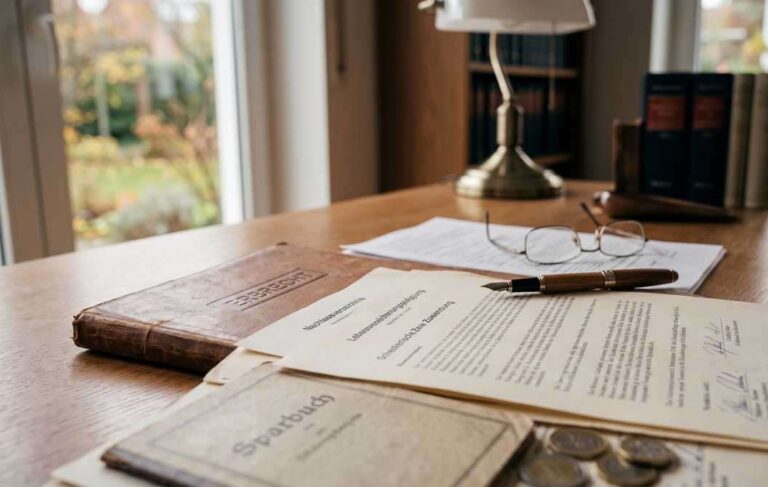
The inventory of the estate arrives, and it is surprisingly brief. A current account with a four-figure balance, a car, household effects. The securities portfolio, which had been the subject of family discussion for years, does not appear on the list…

For a house, there is the land register. For a bank account, there is a bank that can provide information. A car is registered, and a share in a company is listed in the commercial register. For a painting…

In many estates, the actual assets are not held in a bank account but are tied up in a house or a flat. It is precisely this that regularly leads to disputes over the statutory share. Anyone who has been disinherited hopes…

When the probate court opens a will, all parties involved receive a copy of its contents together with what is known as the ‘minutes of the opening’. In many families, these contain two terms that will determine the course of events for decades to come. The…

A will in favour of the children, an inheritance agreement drawn up years ago, or a disposition in which one’s own name simply does not appear. For surviving spouses, this is not… following the opening of the will

Her grandmother has died; the will names her aunt as sole heir; and her own father, who was her link to her grandmother, has been dead for years. In such situations…

An envelope from the probate court, containing a copy of a will, and as you read it, it becomes clear that you will not be inheriting anything. Sometimes it is stated quite clearly; often, it simply says that others…

When the will is read out, many children learn for the first time what their parents agreed years ago. Their father and mother have named each other as sole heirs; the children are to…

A will is opened, and your own name is missing. Instead, a sibling inherits everything, or the father’s second wife, or someone else entirely. For those who have been passed over, this is often…

The first question is almost always whether one can still make any claim at all from such a great distance. The answer is rather unremarkable. As far as the compulsory share is concerned, it does not depend on…

Many disinherited children were never consciously disinherited. They are listed second in their parents’ Berlin will and are therefore excluded from the line of succession upon the first death. Others read in the…

The house has long since been transferred to another’s name, the investment portfolio has been wound up, and there is hardly anything left in the bank accounts. Anyone who has been disinherited and claims their statutory share following a death therefore often finds themselves facing a second…

Anyone considering renouncing an inheritance almost always does so for one of two reasons. Either there is a suspicion that the estate is heavily in debt and that they might end up having to pay for…

In many families, things tend to unfold in a similar way. Parents transfer ownership of the house to one of their children whilst they are still alive, usually with the aim of clarifying the situation and avoiding disputes.…
Nobody takes the initiative to sort out the compulsory share. No probate court calculates it, no authority pays it out, and the heirs do not even have to inform disinherited relatives that they are entitled to something…

Behind the question of the statutory share for siblings, there are almost always two very different situations. The first is easily explained. A brother or sister has died, and the will is being disregarded…

In Switzerland, a letter to the heirs in which you specify the amount of your statutory share and set a payment deadline has less effect than most people expect. It does not oblige anyone to do anything, nor does it…

Anyone in Switzerland who has been omitted from a will and is looking to sell their statutory share almost inevitably ends up dealing with German providers and subject to German rules. In Germany, the statutory share is a…

The statutory share is payable from the date of death. Not after the will has been opened, not after the grant of probate, not once the house has been sold, but immediately. Anyone reading this sentence for the first time,…

The conversation with the legal expenses insurer is usually brief. They say that inheritance law isn’t covered, and even if it is, it’s limited to a consultation. Anyone who doesn’t have a policy at all will reach the same conclusion even more quickly…

It is rare for less than half a year to elapse between the death and the payout. If a dispute arises, this period regularly extends to three or four years. The amount involved is hardly ever the deciding factor…
A will may exclude you, but it can only deprive you of your statutory share in very rare, exceptional cases. Children, spouses and, in some cases, the parents of the deceased retain a legal right to…

In most cases, someone who has been disinherited is not left empty-handed. The law guarantees close relatives a compulsory share, which is a financial claim against the heirs. However, this claim only pays off…

The will has been opened, and your name does not appear in it. Or you have been left significantly less than you would have expected as a child or spouse. In this situation, the question arises…

Almost everyone who has been left out of a will has done the maths in their head at some point. Their widowed mother’s house is likely to be worth around 500,000 euros, and there was… in the bank account

If a property forms part of an estate, those entitled to a compulsory share are often told: „There’s no money; it’s all tied up in the house.“ This explanation may be well-intentioned and, in the…

A will takes effect just once, at the moment of death. After that, it is up to the heirs to decide whether the business is sold, whether the property remains in the family, and who ends up in dispute with whom…

Anyone who inherits normally receives both the assets and the right to dispose of them. The execution of a will separates the two. The house, bank accounts and investment accounts belong to the heirs. Someone is authorised to sell, transfer funds and close accounts…

Most married couples who draw up a joint will have the same aim. Whoever passes away first should leave the other partner financially secure. The house should stay where it is, and the children should…

For many people, the issue of the compulsory share begins with a letter from the probate court. The will has been opened, and their own name does not appear in it, or only with a smaller share than…

Even in the first few weeks following a death, those entitled to a compulsory share often hear the phrase: „This is an inheritance agreement, notarised. Nothing can be done to change it now.“ Sometimes this comes from the heir,…

You will not find the term ‘staged claim’ in any statute book. It originates from the practice of inheritance law and refers to something very specific, namely the way in which a compulsory share is claimed out of court when the…